Introduction: A Historic Bet That Is Reshaping Global Technology
In early 2026, Amazon made a declaration that stopped Wall Street in its tracks. CEO Andy Jassy unveiled a Amazon AI Strategy 2026: $200B Investment for fiscal year 2026, the single largest private-sector infrastructure investment ever recorded. This was not a speculative pivot or a reactive move. It was a calculated, demand-driven escalation rooted in the explosive growth of Amazon Web Services (AWS) and the surging appetite for AI compute worldwide. The announcement immediately sparked conversation about the AI Impact on Jobs, competitive dynamics in cloud computing, and what this scale of spending truly means for the future of the digital economy.
Amazon’s total revenues reached $716.9 billion in 2025, growing 12% year-over-year, with AWS alone generating $128.7 billion. The AWS AI revenue run rate crossed $15 billion in Q1 2026 alone, growing at nearly 260 times the pace AWS experienced at a comparable stage in its early history. These are not aspirational projections. These are numbers backed by committed customer contracts, including a landmark $100+ billion commitment from OpenAI, making AWS the compute backbone for some of the world’s most advanced AI models.
This case study breaks down the strategy behind Amazon’s $200 billion commitment, examining five critical dimensions: AWS infrastructure expansion, custom silicon development, the full-stack AI architecture, competitive risks, and the real-world impact on the global workforce. Whether you are an investor, a technology professional, a business leader, or a policy analyst, understanding this investment is essential to grasping where the global AI economy is heading next.
AWS Infrastructure Surge Powers Next-Generation Cloud Demand
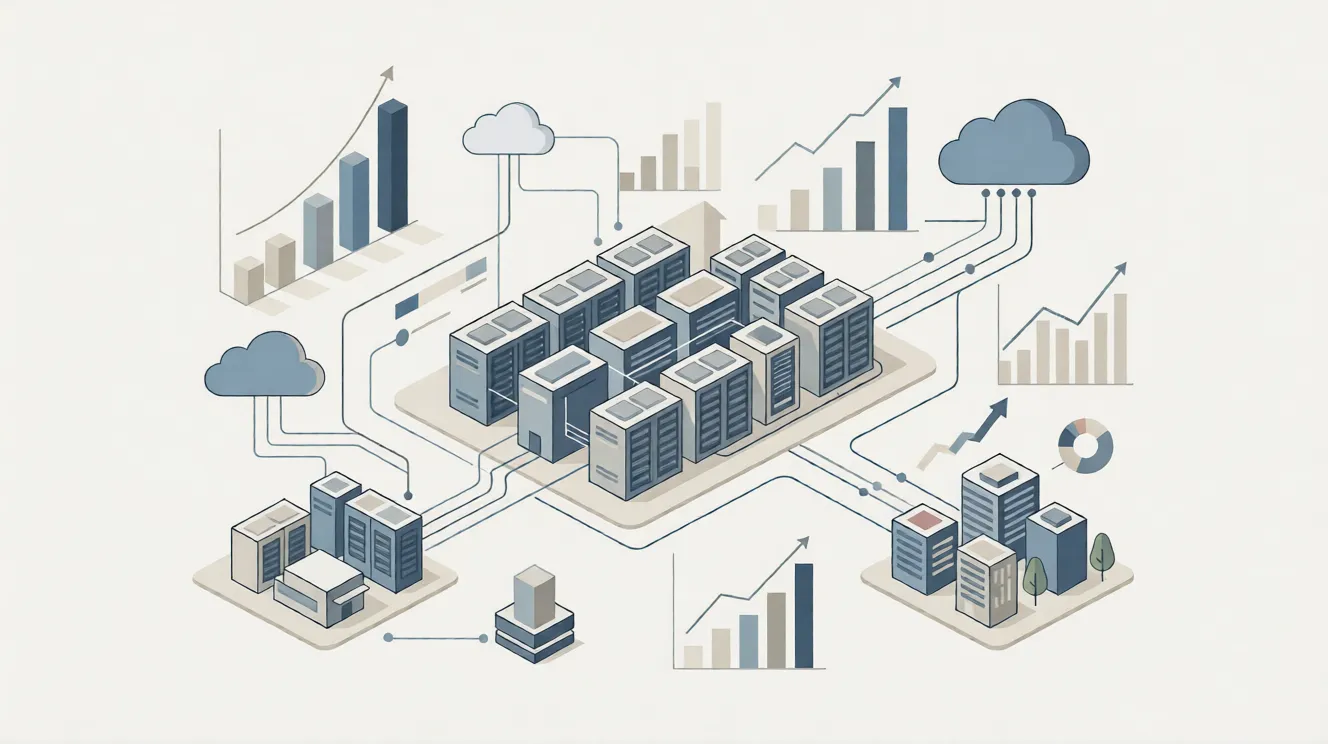
The backbone of Amazon’s $200 billion commitment is the physical expansion of AWS. The cloud giant added 3.9 gigawatts of new power capacity in 2025 alone and is on track to double its total power capacity by the end of 2027. Data centers are being constructed at an unprecedented pace, with major domestic investments including $15 billion in Indiana and $12 billion in Louisiana. These facilities are not generic compute farms. They are purpose-built AI factories optimized for high-density GPU and custom chip workloads.
The strategy behind this buildout reflects a sophisticated understanding of the ai infrastructure demand 2026 cloud computing landscape. Enterprises are not merely adopting AI tools. They are rebuilding their entire technology stacks around AI-native architectures, and they need cloud providers that can supply compute at a scale and reliability previously unimaginable. AWS’s revenue backlog reached $244 billion in Q4 2025, growing 38% year-over-year, signaling that committed demand already justifies much of the planned spend.
Jassy has been transparent about one critical constraint: AWS faces genuine capacity shortfalls. Demand is outstripping the company’s ability to install and monetize infrastructure fast enough. This is not a problem of weak demand but of supply lagging behind an accelerating market. The company is investing in nuclear energy partnerships, including Small Modular Reactors (SMRs) with Dominion Energy and Constellation Energy, to secure reliable, carbon-free baseload power for its AI data centers.
AWS Key Performance Metrics:
| AWS Metric | Value | Growth Rate |
|---|---|---|
| AWS Annual Revenue Run Rate (Q4 2025) | $142 Billion | +24% YoY |
| AWS AI Revenue Run Rate (Q1 2026) | $15+ Billion | +260x vs. early AWS |
| AWS Revenue Backlog (Q4 2025) | $244 Billion | +38% YoY |
| 2026 Capital Expenditure Plan | $200 Billion | +52% vs. 2025 |
| Projected AWS Revenue by 2036 | $600 Billion (internal) | Long-term AI-driven estimate |
Custom Silicon Strategy Breaks the Dependency on Third-Party Chips
One of the most understated dimensions of Amazon’s AI strategy is its custom silicon portfolio. While competitors largely depend on NVIDIA for GPU supply, Amazon has built a proprietary chip ecosystem comprising Graviton CPUs, Trainium AI accelerators, and Nitro networking infrastructure. Collectively, these products have crossed a $20 billion annual revenue run rate, growing at triple-digit percentages year-over-year. Trainium2 chips have already sold out, underscoring the depth of enterprise demand.
This silicon strategy is inseparable from the debate over AI vs Human Content creation, model training economics, and inference efficiency. Training large language models and running real-time AI inference at scale requires massive computational resources. By owning its chip supply chain, Amazon can control both the cost and the performance of its AI infrastructure. Jassy estimates that at scale, Trainium will save tens of billions in annual capital expenditure and deliver hundreds of basis points of operating margin advantage over third-party chip-dependent architectures.
Beyond internal use, Amazon is exploring selling Trainium chips and entire pre-configured server racks to enterprise customers, creating a new hardware revenue stream that competes directly with the ‘AI infrastructure as a product’ market. The Bedrock inference engine, codenamed “Mantle,” and the rebuilt Alexa+ platform both run on this custom silicon foundation. Amazon’s chips business is no longer a cost-reduction tool but a revenue-generating product category in its own right.
Silicon Product Impact:
| Amazon Silicon Product | Primary Function | Revenue / Impact |
|---|---|---|
| Graviton CPUs | General-purpose cloud compute | Part of $20B+ chip run rate |
| Trainium AI Chips | AI model training & inference | Trainium2 sold out; triple-digit growth |
| Nitro Networking | High-throughput data fabric | Core AWS infrastructure layer |
| Bedrock “Mantle” Engine | AI inference optimization | Reduces cost per AI query at scale |
| Custom Rack Sales (planned) | Enterprise hardware product | New B2B revenue stream in 2026 |
Full-Stack Architecture Connects Cloud, Edge, and Consumer AI Products
Amazon’s strategy is not confined to building data centers. CEO Jassy has described it as a amazon full stack ai strategy that spans every layer of the technology stack, from the silicon chip inside a data center to the AI assistant inside a consumer’s home. This architecture encompasses Bedrock, the company’s managed AI model platform; Alexa+, the generative AI-powered voice assistant now operating on a subscription model; robotics in fulfillment centers; and Amazon Leo, the low Earth orbit satellite network that has secured commercial partnerships with Delta Air Lines, JetBlue, AT&T, Vodafone, and NASA.
The full-stack approach also has direct implications for Web Development and enterprise application ecosystems. Through AWS Bedrock, developers and businesses can build AI-native applications without managing underlying model infrastructure. This positions Amazon as the foundational platform for the next generation of software products. The OpenAI partnership, valued at over $100 billion in committed infrastructure spend, validates Amazon’s role as the preferred compute backbone for even the most sophisticated AI developers in the world.
Meanwhile, Amazon’s grocery business exceeded $150 billion in gross sales in 2025, Prime Air drone delivery is targeting communities with 30 million customers by year-end, and Amazon Now ultra-fast delivery is growing 25% month-over-month in India. These non-cloud businesses are increasingly AI-optimized, benefiting from the same infrastructure investments driving AWS growth. The flywheel of data, compute, and consumer scale is accelerating.
| Full-Stack Layer | Amazon Product / Service | Strategic Role |
|---|---|---|
| Custom Silicon | Trainium, Graviton, Nitro | Control cost and performance at compute layer |
| Cloud Infrastructure | AWS Data Centers (200+ regions) | Global AI compute backbone |
| AI Platform | Amazon Bedrock + Mantle Engine | Managed AI model deployment for enterprise |
| Consumer AI | Alexa+ (Generative AI) | Subscription-based personal AI agent |
| Connectivity | Amazon Leo Satellite Network | Global broadband for edge AI applications |
| Physical AI | Fulfillment Robots + DeepFleet AI | Automation of logistics and delivery network |
Competitive Positioning Against Microsoft and Google in the Cloud Race

The $200 billion commitment does not exist in isolation. Amazon, Microsoft, and Google combined are expected to invest over $650 billion in AI infrastructure in 2026 alone. Microsoft has allocated roughly $80 billion for fiscal year 2026, while Alphabet has projected up to $185 billion. The scale of this arms race is reshaping energy markets, real estate, semiconductor supply chains, and the global talent market simultaneously.
AWS currently holds approximately 31% of the global cloud market share, compared to Microsoft Azure at 22% and Google Cloud at 14%. AWS grew at 24% year-over-year on a $142 billion revenue base, the largest absolute base of any cloud provider. While Azure showed a higher percentage growth rate of 39%, it did so on a smaller base. This distinction matters when evaluating long-term market dynamics. The amazon ai strategy aws prioritizes margin leadership and infrastructure depth over percentage growth comparisons, betting that enterprise stickiness and custom silicon will ultimately win the economics war.
Microsoft has recently encountered power bottlenecks, reportedly unable to fulfill nearly $80 billion in Azure orders due to grid constraints. This is precisely the gap Amazon is targeting with its proactive energy investments. The OpenAI infrastructure deal, originally viewed as a Microsoft exclusive, now places a majority of compute workloads on AWS, fundamentally altering the competitive narrative. Amazon’s AWS backlog of $244 billion represents more committed future revenue than many Fortune 500 companies generate in total annual sales.
Risk Assessment Summary:
| Cloud Provider | 2026 Capex Plan | Cloud Market Share | AWS / Azure / GCP Revenue | Key Differentiator |
|---|---|---|---|---|
| Amazon AWS | $200 Billion | 31% | $142B run rate (+24%) | Custom silicon + OpenAI deal |
| Microsoft Azure | ~$80 Billion | 22% | Growing +39% (smaller base) | Microsoft 365 integration |
| Google Cloud | ~$185 Billion | 14% | Rapid growth from lower base | TPU chips + Gemini AI |
| Combined Big 3 | $465+ Billion | 67%+ | Total cloud market dominance | Capital intensity as moat |
Investment Risks, Workforce Disruption, and the True Cost of Transformation
No case study of this magnitude is complete without examining the downside. Amazon’s $200 billion bet carries substantial risks of amazon ai investment that extend well beyond balance sheet pressure. Free cash flow dropped sharply from $38 billion in 2024 to $11 billion in 2025, driven by a $50.7 billion year-over-year increase in capital expenditures. The company’s stock experienced a 12% correction in early 2026 as investors digested the magnitude of planned spending. The core financial risk is over-building: if AI demand decelerates, or if monetization of large language models takes longer than anticipated, the return on this investment could be significantly delayed.
The workforce disruption is equally significant. Amazon confirmed 16,000 corporate layoffs in January 2026, following 14,000 cuts in October 2025, bringing total reductions to nearly 30,000 roles, the largest workforce reduction in the company’s history. The affected divisions include AWS, retail operations, HR, and engineering. The amazon ai infrastructure strategy explained to investors as an efficiency-driven transformation. Jassy has stated directly that as generative AI and agents scale across the company, “we will need fewer people doing some of the jobs being done today.” Amazon’s one-millionth warehouse robot was deployed in early 2026, with its DeepFleet AI improving fleet efficiency by 10%.
Additional risk vectors include regulatory scrutiny across the EU and US, potential technological obsolescence if Trainium chips fail to keep pace with NVIDIA’s next-generation roadmap, unionization efforts at US fulfillment centers creating operational friction, and the broader geopolitical risks of sovereign AI cloud demands requiring regional infrastructure duplication. Despite these challenges, the weight of evidence, including $244 billion in committed backlog and sold-out AI chip capacity, suggests that demand risk is currently lower than execution risk.
| Risk Category | Specific Risk | Severity | Amazon’s Mitigation |
|---|---|---|---|
| Financial | Free cash flow compression from capex | High | OpenAI $100B committed deal provides revenue anchor |
| Workforce | 30,000 layoffs + ongoing automation | High | $2.5B skills training commitment by Amazon |
| Technology | Trainium vs. NVIDIA performance gap | Medium | Triple-digit chip revenue growth validates demand |
| Regulatory | EU AI Act + US antitrust scrutiny | Medium | Regional sovereign cloud investments underway |
| Market | AI demand cooling or LLM monetization lag | Medium-Low | $244B backlog already committed by customers |
| Energy | Power grid constraints for data centers | Medium | SMR nuclear partnerships + 3.9GW added in 2025 |
Conclusion
The Amazon AI Strategy 2026: $200B Investment Explained represents more than a corporate capital allocation decision. It is a declaration that the AI era requires physical infrastructure at a scale previously associated with national energy grids or interstate highway systems. Amazon’s approach, spanning proprietary silicon, massive data center buildouts, nuclear energy partnerships, satellite broadband, and consumer AI, is designed to make retreat impossible for competitors and switching costly for customers. The financial pressure is real, but the strategic logic is coherent and defensible given the committed backlog and the trajectory of AI adoption across every industry sector.
From a workforce and societal lens, the transformation is creating genuine disruption alongside genuine opportunity. The same investment that has eliminated nearly 30,000 corporate roles at Amazon is funding a new class of AI infrastructure jobs, machine learning engineering positions, and chip design roles that did not exist five years ago. The net effect on employment remains contested, but the structural shift toward ai infrastructure demand 2026 cloud computing is undeniable. Organizations that proactively reskill their teams, adopt AI-native tooling, and align their technology roadmaps with cloud-first architectures will be far better positioned to benefit from this transition than those waiting on the sidelines.
This is a latest case-study grounded in verified data from Amazon’s 2025 annual results, CEO Andy Jassy’s shareholder letter, and Q1 2026 earnings disclosures. The six key takeaways from this analysis are:
- AWS revenue backlog reached $244 billion, growing 38% year-over-year, validating long-term demand.
- Custom chip revenue crossed $20 billion annually, reducing reliance on external suppliers and improving margins.
- The OpenAI infrastructure agreement repositioned Amazon as the primary compute home for frontier AI models.
- Nuclear energy and power partnerships are addressing the single biggest constraint on data center expansion.
- Workforce restructuring is accelerating, with 30,000 roles eliminated and robotics deployments scaling rapidly.
- Competitive capital intensity is establishing infrastructure scale as the defining moat in the AI cloud market.
If you want to understand how this investment affects your business, technology strategy, or career path, the right move is to act now. Align your digital roadmap with the AI-native future that Amazon, alongside Microsoft and Google, is actively constructing. The window to adapt is open, but the pace of change is accelerating. Staying informed through credible, well-researched resources like this is the first step. The next step belongs to you. Reach out to a qualified technology advisor or visit Digital Jagdish to begin building your AI-ready strategy today while there’s still a clear runway ahead.